Pro Pilkki 2 fish species
The game has 32 fish species. The species information comes from Finnish Wikipedia articles (translated into English); the maps are taken from the game's own map descriptions.
Pike · Perch · Roach · Ruffe · Whitefish · Bream · Trout · Burbot · Rudd · Silver bream · Bleak · Ide · Zander · Dace · Rainbow trout · Crucian carp · Grayling · Smelt · Three-spined stickleback · Zope · Vendace · Arctic charr · Bull-rout · Salmon · Viviparous · Chub · Lake trout · Tench · Baltic herring · Brook trout · Sabrefish · Asp
Pike (Esox lucius)


The northern pike (Esox lucius) is a predatory fish living in inland and coastal waters, found across most of northern Eurasia and North America. It is a vigorous species with a wide range that copes in many kinds of lakes and rivers as well as the low-salinity Baltic Sea. The pike's body is elongated and slender, and its fins are at the rear end.
- Size: In favourable conditions a female pike can grow to as much as one and a half metres and 35 kilograms.
- Habitat: The pike is found in Europe, Asia and North America.
- Food: It switches from zooplankton to a fish diet quite early, in its first summer when less than 10 centimetres long.
- Reproduction: A pike's first spawning is influenced by several factors, including temperature and the availability of food.
Occurs on 46 maps: Haapolahti, Harjukankaan monttu, Haukilahti, Hossalaislammet, Iso-Ruuhijärvi, Iso-Söimi, Jormuanlahti, Kivijoki, Koivusaaren matalikko, Kolmisoppi, Korpipuro, Kortejärvi, Kuikansalmi, Kuopionlahti, Lahnalammet, Lehmilampi, Linlonlahti, Lokkiluoto, Meri, Metsälampi, Muddusjärvi, Mustalampi, Mäntylahti, Niemisjärvet, Palusjärvi, Peräjärvi, Pieni Särkinen, Pitkälampi, Pohjalampi, Rautupuro, Ruippo, Räväjärvi, Rönttäoja, Saarijärvi, Savilahti, Siika-valkeinen, Siikakoski, Surrinlampi, Särkijärvi, Taivallampi, Telkänlampi, Ullavanjärvi, Venetjoen tekojärvi, Viitalampi, Vuolasniva, Vuontele
Source: Wikipedia (Finnish): Hauki
Perch (Perca fluviatilis)


The European perch (Perca fluviatilis) is a fish species living in fresh and brackish waters in Eurasia. It is usually greenish with dark vertical stripes. Its pelvic fins and tail are red-orange.
- Size: Most often a perch is 15–30 centimetres long and weighs 50–350 grams.
- Habitat: The range of the perch in inland waters covers almost all of Europe except Italy and Spain and extends to the Kolyma River in Siberia.
- Food: A small perch feeds on zooplankton; with age, bottom animals and small fish join the diet.
- Reproduction: The perch spawns in spring, around April–June, when the water temperature exceeds six degrees.
Occurs on 44 maps: Haapolahti, Harjukankaan monttu, Haukilahti, Hossalaislammet, Iso-Ruuhijärvi, Iso-Söimi, Jormuanlahti, Kivijoki, Koivusaaren matalikko, Kolmisoppi, Korpipuro, Kortejärvi, Kuikansalmi, Kuopionlahti, Lahnalammet, Lehmilampi, Linlonlahti, Lokkiluoto, Meri, Metsälampi, Muddusjärvi, Mustalampi, Mäntylahti, Niemisjärvet, Palusjärvi, Peräjärvi, Pieni Särkinen, Pitkälampi, Pohjalampi, Ruippo, Räväjärvi, Rönttäoja, Saarijärvi, Savilahti, Siika-valkeinen, Siikakoski, Surrinlampi, Särkijärvi, Taivallampi, Telkänlampi, Ullavanjärvi, Venetjoen tekojärvi, Viitalampi, Vuontele
Source: Wikipedia (Finnish): Ahven
Roach (Rutilus rutilus)


The roach (Rutilus rutilus) is a freshwater and brackish-water fish species of the order Cypriniformes found in western Asia and Europe except the Mediterranean region. It has also been moved to many countries outside its original range, mainly for recreational fishing. The roach is an elongated, laterally flattened species with silvery sides, red eyes and red pelvic fins.
- Size: The roach usually grows to 10–25 centimetres in length, and at most to 30–35 centimetres and 300–500 grams.
- Habitat: The natural range of the roach extends from the western parts of Asia to almost all of Europe except the Mediterranean region.
- Food: The roach eats planktonic crustaceans, bottom animals, snails, blue mussels and sometimes also aquatic plants.
- Reproduction: The roach spawns in spring when the water temperature has exceeded 10 degrees Celsius.
Occurs on 40 maps: Haapolahti, Harjukankaan monttu, Haukilahti, Hossalaislammet, Iso-Ruuhijärvi, Jormuanlahti, Kivijoki, Koivusaaren matalikko, Kolmisoppi, Korpipuro, Kortejärvi, Kuikansalmi, Kuopionlahti, Lahnalammet, Lehmilampi, Linlonlahti, Lokkiluoto, Metsälampi, Muddusjärvi, Mustalampi, Mäntylahti, Niemisjärvet, Palusjärvi, Peräjärvi, Pieni Särkinen, Pohjalampi, Ruippo, Räväjärvi, Rönttäoja, Saarijärvi, Savilahti, Siika-valkeinen, Siikakoski, Surrinlampi, Särkijärvi, Taivallampi, Ullavanjärvi, Venetjoen tekojärvi, Viitalampi, Vuontele
Source: Wikipedia (Finnish): Särki
Ruffe (Gymnocephalus cernua)
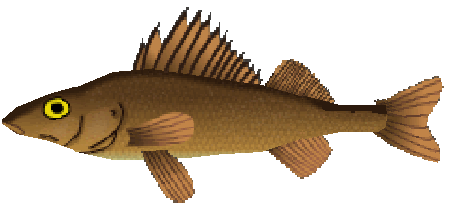


The ruffe (Gymnocephalus cernua, formerly Gymnocephalus cernuus) is a small fish species belonging to the perch family (Percidae).
- Size: A fully grown ruffe is usually 7–15 centimetres long and rarely bigger than this.
- Habitat: This species is native to the waters of the Caspian Sea, the Black Sea, the Baltic Sea and the North Sea, including Great Britain.
- Food: The ruffe eats mainly the larvae of non-biting midges, but water fleas, copepods and fish roe are also eaten.
Occurs on 39 maps: Haapolahti, Harjukankaan monttu, Haukilahti, Hossalaislammet, Iso-Ruuhijärvi, Jormuanlahti, Kivijoki, Koivusaaren matalikko, Kolmisoppi, Kortejärvi, Kuikansalmi, Kuopionlahti, Lahnalammet, Lehmilampi, Linlonlahti, Lokkiluoto, Meri, Metsälampi, Muddusjärvi, Mäntylahti, Niemisjärvet, Palusjärvi, Peräjärvi, Pieni Särkinen, Pitkälampi, Pohjalampi, Ruippo, Räväjärvi, Rönttäoja, Saarijärvi, Savilahti, Siika-valkeinen, Surrinlampi, Särkijärvi, Taivallampi, Ullavanjärvi, Venetjoen tekojärvi, Viitalampi, Vuontele
Source: Wikipedia (Finnish): Kiiski
Whitefish (Coregonus lavaretus)


The European whitefish (Coregonus lavaretus) is a schooling fish of the order of salmonids living in the inland and brackish waters of the northern parts of Eurasia. The whitefish is an extremely diverse fish, of which very different forms or populations in morphology, diet, growth rate and spawning behaviour can live even in the same lake. In Finland five or six main whitefish forms have been distinguished: bottom whitefish, reef whitefish, migratory whitefish, lake whitefish, plankton whitefish and sheathfish.
- Size: The fastest-growing form is the migratory whitefish, which at 7 years old is about 50 cm long and weighs about 1 kg.
- Habitat: The range of the whitefish extends from western and central Europe across northern Asia.
- Food: As a fry the whitefish eats zooplankton.
- Reproduction: The whitefish reaches sexual maturity on average at 4–5 years of age.
Occurs on 24 maps: Harjukankaan monttu, Haukilahti, Hossalaislammet, Iso-Ruuhijärvi, Iso-Söimi, Jormuanlahti, Koivusaaren matalikko, Kuikansalmi, Kuopionlahti, Linlonlahti, Meri, Muddusjärvi, Niemisjärvet, Peräjärvi, Rautupuro, Ruippo, Räväjärvi, Savilahti, Siika-valkeinen, Siikakoski, Surrinlampi, Taivallampi, Vuolasniva, Vuontele
Source: Wikipedia (Finnish): Siika
Bream (Abramis brama)


The common bream (Abramis brama) is a European fish species belonging to the carp-minnow family (Leuciscidae). It is the only species of its genus Abramis.
- Size: The bream can grow to 25–50 centimetres in length, but bigger ones exist too.
- Habitat: The range of the bream in inland waters covers most of Europe from the Adour river system to the Pechora river system.
- Food: As a fry the bream feeds on zooplankton, but as an adult it eats molluscs and larvae.
- Reproduction: It spawns in batches throughout spring and early summer when the water is over 15 degrees.
Occurs on 19 maps: Haapolahti, Jormuanlahti, Koivusaaren matalikko, Kuikansalmi, Kuopionlahti, Lahnalammet, Lehmilampi, Linlonlahti, Lokkiluoto, Mäntylahti, Palusjärvi, Peräjärvi, Rönttäoja, Saarijärvi, Savilahti, Ullavanjärvi, Venetjoen tekojärvi, Viitalampi, Vuontele
Source: Wikipedia (Finnish): Lahna
Trout (Salmo trutta)


The brown trout (Salmo trutta) is a European salmonid species that closely resembles the salmon in appearance.
- Size: The brown trout is also smaller than the salmon, usually 35–70 cm in length.
- Habitat: The natural range of the brown trout is limited to Europe, where it is found almost everywhere except the Mediterranean countries and south-eastern Europe.
- Reproduction: A female brown trout reaches sexual maturity at three to five years of age.
Occurs on 18 maps: Iso-Ruuhijärvi, Iso-Söimi, Jormuanlahti, Koivusaaren matalikko, Korpipuro, Kuikansalmi, Kuopionlahti, Linlonlahti, Lokkiluoto, Meri, Muddusjärvi, Niemisjärvet, Rautupuro, Räväjärvi, Saarijärvi, Siikakoski, Vuolasniva, Vuontele
Source: Wikipedia (Finnish): Taimen
Burbot (Lota lota)


The burbot (Lota lota), also called matikka in Finnish, is the only freshwater species of the cod family. It is the only species of its genus Lota.
- Size: The biggest burbot recorded in Finland in the 2000s weighed 8.04 kilograms.
- Habitat: The burbot is found in almost all Finnish lakes and also in sea areas.
- Food: The burbot is a predator and eats mainly fish.
- Reproduction: The burbot spawns in January–March.
Occurs on 18 maps: Haapolahti, Haukilahti, Jormuanlahti, Koivusaaren matalikko, Kuikansalmi, Kuopionlahti, Linlonlahti, Lokkiluoto, Muddusjärvi, Peräjärvi, Rönttäoja, Saarijärvi, Savilahti, Siika-valkeinen, Siikakoski, Ullavanjärvi, Venetjoen tekojärvi, Vuontele
Source: Wikipedia (Finnish): Made
Rudd (Scardinius erythrophthalmus)
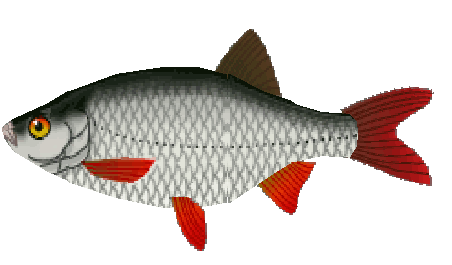


The rudd (Scardinius erythrophthalmus) is a fish found in Europe and central Asia. The rudd resembles the roach in appearance, but it has red fins and yellow eyes and is broader than the roach; in addition, adult individuals have a coppery-brown tone on their sides. It is also called "punakontti" (red-tail) because of the colour of its fins.
- Size: The rudd grows to 15–25 cm in length.
Occurs on 17 maps: Haapolahti, Koivusaaren matalikko, Kortejärvi, Kuopionlahti, Lahnalammet, Lehmilampi, Linlonlahti, Lokkiluoto, Metsälampi, Palusjärvi, Peräjärvi, Pieni Särkinen, Savilahti, Surrinlampi, Särkijärvi, Ullavanjärvi, Vuontele
Source: Wikipedia (Finnish): Sorva
Silver bream (Blicca bjoerkna)


The silver bream (Blicca bjoerkna) is a fish species of the carp-minnow family that thrives in nutrient-rich inland and brackish waters. The silver bream is the only species of its genus (Blicca). The silver bream is not used much as human food because it is a bony and bland-tasting fish.
- Size: The silver bream grows to a length of 20–25 centimetres and weighs less than a kilo.
- Habitat: The silver bream is found in Europe from France to the Urals, but not in Italy, Greece and the countries of the former Yugoslavia.
- Food: The most common food of the silver bream is insect larvae, isopods and pea mussels.
- Reproduction: The silver bream spawns in June or July when the water temperature is over 17 degrees Celsius.
Occurs on 17 maps: Haapolahti, Jormuanlahti, Koivusaaren matalikko, Kortejärvi, Kuikansalmi, Kuopionlahti, Lahnalammet, Lehmilampi, Linlonlahti, Lokkiluoto, Mäntylahti, Palusjärvi, Peräjärvi, Pieni Särkinen, Savilahti, Särkijärvi, Vuontele
Source: Wikipedia (Finnish): Pasuri
Bleak (Alburnus alburnus)


The bleak (Alburnus alburnus) is a silvery-bright fish species of the carp-minnow family living in fresh and brackish water.
- Size: The bleak is usually 10–15 cm long, and its weight is rarely over 40 g.
- Habitat: The bleak occurs naturally in a large part of Europe north of the Pyrenees, the Alps, the Caucasus and the Caspian Sea, but not in Ireland and most of England.
- Food: The bleak eats insects from the water surface as well as zooplankton.
- Reproduction: The spawning time of the bleak varies even within the same water system so that it may be divided into as many as three different periods.
Occurs on 16 maps: Haapolahti, Haukilahti, Jormuanlahti, Kivijoki, Koivusaaren matalikko, Kuikansalmi, Kuopionlahti, Lahnalammet, Lokkiluoto, Mäntylahti, Palusjärvi, Peräjärvi, Rönttäoja, Saarijärvi, Savilahti, Vuontele
Source: Wikipedia (Finnish): Salakka
Ide (Leuciscus idus)


The ide (Leuciscus idus), called säyne in Finnish, is a relatively large fish species of the cyprinids. It resembles the roach but is bigger, smaller-scaled and yellow-eyed.
- Size: The ide is large for a cyprinid: it usually grows to 40–50 cm long and weighs from half a kilo to over two kilos.
- Habitat: The ide is an inland-water fish of northern Eurasia whose range extends from the Lena River in eastern Siberia to the Rhine system in western Europe.
- Food: Ides eat many kinds of bottom animals, especially molluscs; big individuals also prey on other fish.
- Reproduction: The ide spawns usually in shallow current spots soon after the ice breaks up.
Occurs on 13 maps: Haapolahti, Koivusaaren matalikko, Kuikansalmi, Kuopionlahti, Lahnalammet, Lehmilampi, Linlonlahti, Mustalampi, Peräjärvi, Savilahti, Siikakoski, Surrinlampi, Vuontele
Source: Wikipedia (Finnish): Säyne
Zander (Sander lucioperca)


The zander (Sander lucioperca, syn. Stizostedion lucioperca) is a Eurasian predatory fish of fresh and brackish waters belonging to the perch family. It is the largest species of its family.
- Size: The length of the zander is usually 30–60 cm and its weight 0.4–2.5 kg.
- Habitat: The zander occurs naturally in eastern, central and northern Europe in numerous water systems flowing into the Baltic Sea, the Black Sea, the Caspian Sea and the Aral Sea, and in the Elbe drainage basin flowing into the North Sea.
- Food: The food of the fry consists at first of zooplankton.
- Reproduction: After spawning in summer the zander stay where the food is best.
Occurs on 12 maps: Haapolahti, Jormuanlahti, Koivusaaren matalikko, Kuopionlahti, Linlonlahti, Lokkiluoto, Mäntylahti, Palusjärvi, Peräjärvi, Saarijärvi, Ullavanjärvi, Vuontele
Source: Wikipedia (Finnish): Kuha
Dace (Leuciscus leuciscus)


The common dace (Leuciscus leuciscus) is a fish species of the carp-minnow family living in fresh and brackish water. In Finland it occurs mostly in eastern and northern Finland, but it is also found in Finland's coastal waters.
- Size: The dace grows to 20–25 centimetres in length, but at most it can be 40 centimetres long.
- Food: The dace eats aquatic and aerial insects, worms, small snails and sometimes plant parts.
- Reproduction: Males have spawning tubercles over the whole body.
Occurs on 11 maps: Haapolahti, Haukilahti, Jormuanlahti, Kivijoki, Kortejärvi, Lahnalammet, Lehmilampi, Peräjärvi, Räväjärvi, Saarijärvi, Vuontele
Source: Wikipedia (Finnish): Seipi
Rainbow trout (Oncorhynchus mykiss)


The rainbow trout (Oncorhynchus mykiss) is a salmonid of the Pacific salmon genus that humans have brought from North America to fish farms in Finland and the rest of Europe. The flesh of the rainbow trout is fatty. The flesh of farmed rainbow trout is very red because synthetic astaxanthin is added to its feed.
- Size: The rainbow trout grows to about 40–70 centimetres in length and weighs about 1–5 kg.
- Habitat: Three ecological forms are distinguished in this fish, originally from the waters flowing into the Pacific south of latitude 60° in North America: a form spending its whole life in running water, a form of cold lakes, and a form that ascends from the sea to rivers to spawn.
Occurs on 10 maps: Hossalaislammet, Iso-Ruuhijärvi, Kolmisoppi, Kuikansalmi, Linlonlahti, Niemisjärvet, Ruippo, Saarijärvi, Surrinlampi, Ullavanjärvi
Source: Wikipedia (Finnish): Kirjolohi
Crucian carp (Carassius carassius)


The crucian carp (Carassius carassius) is a fish species of the carp order and the carp family (Cyprinidae). The crucian carp used to be classified in the carp genus Cyprinus, but it is now classified in its own genus Carassius, which also includes, among others, the goldfish.
- Size: In low-oxygen ponds crucian carp grow only 10–15 cm long and are deep-bodied and big-headed.
- Food: The crucian carp is an omnivorous fish.
Occurs on 8 maps: Koivusaaren matalikko, Kortejärvi, Lahnalammet, Metsälampi, Mäntylahti, Palusjärvi, Ruippo, Vuontele
Source: Wikipedia (Finnish): Ruutana
Grayling (Thymallus thymallus)


The grayling (Thymallus thymallus) is an elongated salmonid found widely in Europe. Its habitat is oxygen-rich, stony or gravelly rivers and lake shores. The grayling is a sedentary species in warm periods, and its spawning typically begins in May–June.
- Size: The grayling grows on average to 25–45 centimetres in length and 400–800 grams in weight.
- Habitat: The grayling lives in oxygen-rich rivers or lake shores with a stony or gravelly bottom.
- Food: The grayling eats many invertebrates, such as snails, crustaceans and the larvae of caddisflies, non-biting midges and blackflies.
- Reproduction: In winter the species is very local and returns to smaller waters in spring before spawning.
Occurs on 7 maps: Iso-Söimi, Muddusjärvi, Rautupuro, Räväjärvi, Siikakoski, Vuolasniva, Vuontele
Source: Wikipedia (Finnish): Harjus
Smelt (Osmerus eperlanus)


The European smelt (Osmerus eperlanus), also called norssi in Finnish, is a smallish fish of inland and brackish waters belonging to the order of smelts, which resemble salmonids. The smelt is translucent, greenish-yellowish and silvery on its sides, with a large mouth with sharp teeth and, like salmonids, an adipose fin on the back near the tail.
- Size: It is 7–20 centimetres long and usually weighs 10–100 grams.
- Habitat: The range of the sea smelt includes the White Sea, the Barents Sea, the Baltic Sea, the North Sea and the North Atlantic coast as far as the Garonne estuary.
Occurs on 7 maps: Jormuanlahti, Kuikansalmi, Kuopionlahti, Linlonlahti, Räväjärvi, Rönttäoja, Saarijärvi
Source: Wikipedia (Finnish): Kuore
Three-spined stickleback (Gasterosteus aculeatus)


The three-spined stickleback (Gasterosteus aculeatus), often called by the folk names rapatuikki and rautakala, is a fish species 4–7 cm long that has, as its name says, three spines on its back. Its body is silver in colour. The three-spined stickleback is a fish of the northern hemisphere found in many kinds of salinity.
- Size: The three-spined stickleback, often called by the folk names rapatuikki and rautakala, (Gasterosteus aculeatus) is a fish species 4–7 cm long that has, as its name says, three spines on its back.
- Habitat: The three-spined stickleback lives in the waters of the temperate zone in the northern hemisphere.
- Reproduction: During the spawning season the male three-spined stickleback builds a nest.
Occurs on 6 maps: Koivusaaren matalikko, Linlonlahti, Lokkiluoto, Meri, Metsälampi, Muddusjärvi
Source: Wikipedia (Finnish): Kolmipiikki
Zope (Ballerus ballerus)


The zope (Ballerus ballerus) is a European freshwater cyprinid species also found in Finland.
- Size: The length is at most 40 cm and the weight usually under a kilo.
- Habitat: The zope occurs in inland waters in the Baltic Sea drainage basin from the Elbe eastwards, in southern Sweden, and in water systems flowing north to the Black Sea and the Caspian Sea.
- Food: The zope eats aquatic insects and other invertebrates such as water fleas and to some extent also plants.
- Reproduction: The zope spawns at the end of May.
Occurs on 6 maps: Haapolahti, Mäntylahti, Peräjärvi, Pieni Särkinen, Särkijärvi, Vuontele
Vendace (Coregonus albula)


The vendace (Coregonus albula) is a salmonid of the whitefish genus (Coregonus), 5–20 centimetres long, which lives in schools in the lakes of northern Europe and in the low-salinity fringes of the Baltic Sea. The vendace is the most important catch of professional inland fishers in Finland. Vendace is caught with trawl, seine, fyke net and small-meshed vendace gill net.
- Size: The length of the vendace is usually 5–20 cm and its weight about 10–70 g.
- Habitat: The vendace is primarily an inland-water fish, found in northern Europe in a narrow area in the countries surrounding the Baltic Sea.
- Food: The vendace eats planktonic crustaceans throughout its life.
- Reproduction: Exceptional cases are also known in which roe and milt have already developed at the age of 5–6 months.
Occurs on 5 maps: Iso-Söimi, Jormuanlahti, Kuopionlahti, Räväjärvi, Siika-valkeinen
Source: Wikipedia (Finnish): Muikku
Arctic charr (Salvelinus alpinus)
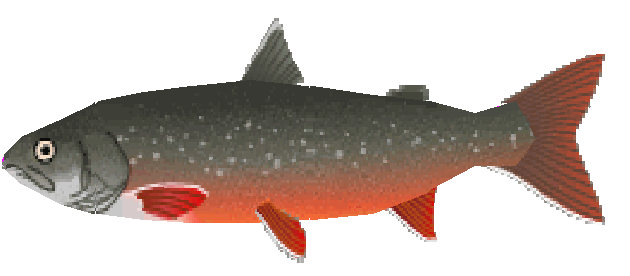


The Arctic char (Salvelinus alpinus) is a fish species of the salmon family (Salmonidae) that lives in cold waters. In Finland it is found in northern Lapland and in the Vuoksi water system in eastern Finland, and in mountain lakes in central Europe. It is the northernmost-living inland-water fish species in the world.
- Size: It grows to about 20–60 cm in length and usually weighs 0.3–1.5 kg.
- Habitat: The range of the char covers lakes, rivers and coastal areas around the northern Arctic Circle on all continents.
- Food: The first food of a char fry after the yolk-sac stage is water fleas, copepods, and the larvae of mosquitoes and blackflies.
- Reproduction: The species spawns in autumn.
Occurs on 4 maps: Iso-Söimi, Muddusjärvi, Rautupuro, Vuolasniva
Source: Wikipedia (Finnish): Nieriä
Bull-rout (Myoxocephalus scorpius)


The shorthorn sculpin (Myoxocephalus scorpius) is a bottom fish of the sea sculpin family found in the Baltic Sea and the North Atlantic. A shorthorn sculpin lifted onto dry land can grunt audibly.
- Size: In the Baltic Sea the shorthorn sculpin grows to about 30 centimetres in length.
- Habitat: The shorthorn sculpin lives on both coasts of the North Atlantic and also on the adjoining shores of the Arctic Ocean and in the Baltic Sea.
- Food: It eats small fish and crustaceans as well as other bottom animals, for example amphipods and mussels.
- Reproduction: The shorthorn sculpin reproduces in winter.
Occurs on 4 maps: Koivusaaren matalikko, Linlonlahti, Lokkiluoto, Meri
Source: Wikipedia (Finnish): Isosimppu
Salmon (Salmo salar)


The Atlantic salmon (Salmo salar) is a fish species of the order of salmonids whose original range is the cool waters of the North Atlantic and the rivers flowing into them. It is an anadromous migratory fish that spends most of its life in the sea but migrates, for example, to Finnish rivers to spawn. The salmon is an important food fish and one of the most produced fish species in fish farming worldwide.
- Size: A caught salmon is usually 70–110 cm long and weighs 3–27 kg.
- Habitat: In Europe the natural range of the salmon covers the Baltic Sea, the Barents Sea, the Norwegian Sea, the North Sea and the rivers and sea areas flowing into the European Atlantic coast as far as Spain and the Minho river in northern Portugal.
- Food: The diet of the fry consists mainly of various invertebrates.
- Reproduction: After 1–2 years, roe and fish fry are added to this diet.
Occurs on 4 maps: Kuopionlahti, Linlonlahti, Lokkiluoto, Meri
Source: Wikipedia (Finnish): Lohi
Viviparous (Zoarces viviparus)


The eelpout (Zoarces viviparus) is a greenish-grey bottom fish living in the Baltic Sea that grows to a length of 20–30 cm and occurs in the bladderwrack zone and on deeper bottoms.
- Size: The biggest eelpout caught in Finland in the 2000s weighed 485 grams.
- Habitat: The eelpout is found in the north-eastern Atlantic: in an area from the White Sea to the Barents Sea and in the south to the English Channel and the waters near the British Isles, as well as in the shallow parts of the Baltic Sea and the North Sea.
- Food: Eelpouts eat bottom animals such as isopods and amphipods.
Occurs on 4 maps: Koivusaaren matalikko, Linlonlahti, Lokkiluoto, Meri
Source: Wikipedia (Finnish): Kivinilkka
Chub (Squalius cephalus)


The chub (Squalius cephalus, formerly Leuciscus cephalus) is a European inland-water cyprinid. In Finland it occurs only in the brackish waters of the southern and south-western coast and in the rivers flowing into them.
- Habitat: The range of the chub in Europe's inland waters extends from the British Isles and the Mediterranean to the Urals and in the north to southern Sweden and Finland.
- Food: The food of the chub is primarily insect larvae, snails, small mussels and worms, but it also eats aquatic plants.
- Reproduction: The chub spawns in May–June, usually in gravel- or sand-bottomed areas, among vegetation.
Occurs on 2 maps: Koivusaaren matalikko, Lokkiluoto
Source: Wikipedia (Finnish): Turpa
Lake trout (Salvelinus namaycush)


The lake trout (Salvelinus namaycush) is a char-type salmonid native to North America. It is the largest char species. The lake trout was brought to Europe in the 1880s and to the Nordic countries around the mid-1950s.
- Size: The average length of the lake trout is 40–80 centimetres and its weight 1–3 kilograms.
- Habitat: Along with the brook trout, the lake trout is the other char species native to North America.
- Food: The lake trout is a predator and eats almost everything, including other fish, crustaceans, insect larvae and zooplankton.
- Reproduction: Like other chars, the lake trout spawns in September–November.
Occurs on 3 maps: Iso-Söimi, Siika-valkeinen, Surrinlampi
Tench (Tinca tinca)


The tench (Tinca tinca) is a cyprinid of inland waters widespread in Eurasia that also lives in the brackish water of the Baltic Sea. The tench is the only species of the tench family (Tincidae) and of its genus.
- Size: Tench caught in Finland are usually 30–40 cm long and weigh 0.3–1.5 kg.
- Habitat: The tench lives in the warm inland waters of southern Finland south of latitude 62.
- Food: It lives near the bottom and eats mainly bottom animals such as crustaceans, worms, snails and insect larvae.
- Reproduction: The tench spawns in early summer in shallow shore water among vegetation.
Occurs on 2 maps: Metsälampi, Palusjärvi
Baltic herring (Clupea harengus membras)


The Baltic herring (Clupea harengus membras), also called haili in Finnish, is a subspecies of herring living in the Baltic Sea. Compared with herring, the Baltic herring is smaller and leaner. Biologically herring and Baltic herring are the same species, that is, they have a similar genome and there is no sharp boundary between them.
- Size: The Baltic herring is usually 14–18 cm long, sometimes even 30–35 cm.
- Reproduction: Most of them spawn in early summer, a small minority in autumn.
Occurs on 2 maps: Linlonlahti, Lokkiluoto
Source: Wikipedia (Finnish): Silakka
Brook trout (Salvelinus fontinalis)


The brook trout (Salvelinus fontinalis) is a salmonid native to North America. It was brought to Europe from there in 1869. The species thrives in cool rivers and clear-water lakes.
- Habitat: The original habitat of the brook trout is the inland waters of north-eastern North America.
- Food: The brook trout eats many invertebrates, such as crustaceans, insect larvae, surface insects and worms.
- Reproduction: In Finland the spawning sites of the species are the gravel bottoms of fast-flowing brooks and rivers in September–October.
Occurs on 2 maps: Korpipuro, Niemisjärvet
Source: Wikipedia (Finnish): Puronieriä
Sabrefish (Pelecus cultratus)


The sichel (Pelecus cultratus) is a fish species belonging to the carp-minnow family (Leuciscidae) and the subfamily Leuciscinae. The sichel grows to a length of about 25 centimetres. It has a sharp appearance.
- Size: The sichel grows to a length of about 25 centimetres.
Occurs on 1 maps: Mäntylahti
Source: Wikipedia (Finnish): Miekkasärki
Asp (Aspius aspius)


The asp (Leuciscus aspius) is a predatory fish of the cyprinids that is rare in Finland. It is the provincial fish of Pirkanmaa.
- Size: The asp grows to 40–100 centimetres in length and 1–3 kilos in weight, sometimes however as much as 12 kilos.
- Habitat: The main range of the asp is eastern and south-eastern Europe.
Source: Wikipedia (Finnish): Toutain
Species information: Wikipedia (suomi) ja Wikidata, licence CC BY-SA 4.0 (Wikipedia), CC0 (Wikidata). Game pictures: Procyon Products. Photographs: Wikimedia Commons, the author and licence are shown under each picture.